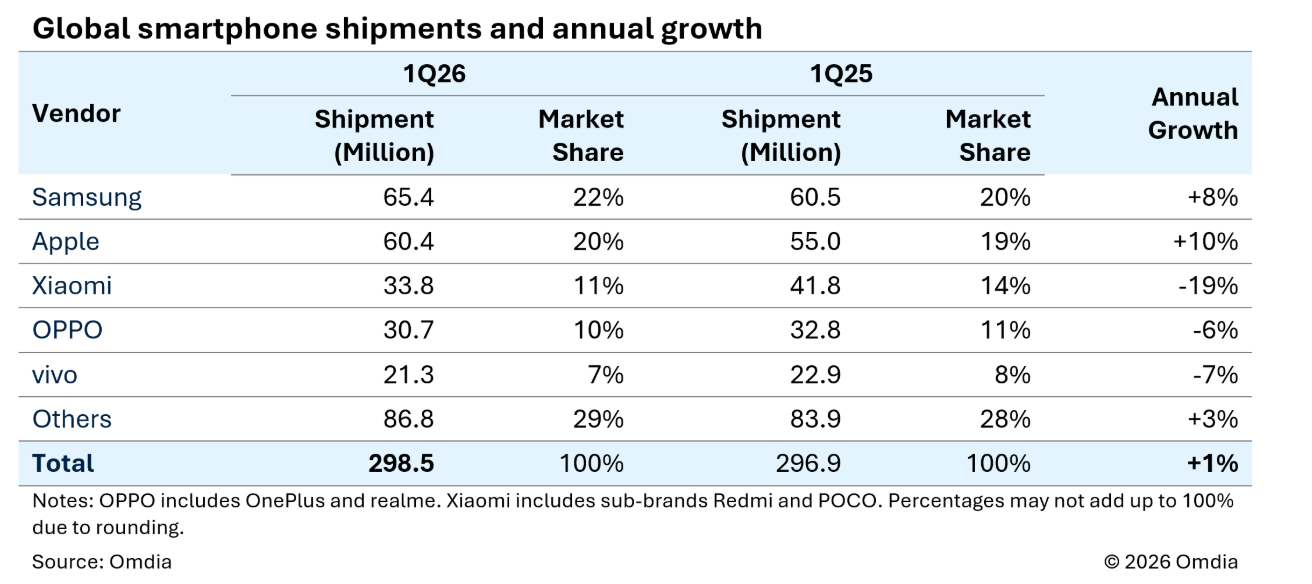
The global smartphone market grew a modest 1% year-on-year in Q1 2026, shipping 298.5 million units. While the numbers exceeded expectations, the growth was largely “artificial.” Major vendors like Samsung and Apple accelerated shipments (front-loading) to get ahead of rising component costs and inflation, even as actual consumer demand remained sluggish due to squeezed household budgets.
Samsung reclaimed the top spot with 65.4 million units (+8%), finding success through a mix of high-end Galaxy S26 demand and steady A-series volume. Apple followed closely with 60.4 million units (+10%), fueled by the iPhone 17 series and a massive 42% growth spurt in Mainland China. In contrast, Xiaomi saw a sharp 19% decline; its reliance on budget-friendly models left it vulnerable to rising memory and storage costs, which ate into its margins.
Other major players like OPPO and vivo saw single-digit declines as they focused on clearing out existing stock. The standout performer outside the top five was HONOR, which grew 19% by doubling its presence in the Middle East and Africa, despite facing heavy competition in its home market of China.
The outlook for the rest of 2026 is cautious. Because vendors over-shipped in Q1 to beat price hikes, the market is now facing an “inventory overhang.” Analysts expect a correction in the second half of the year, where shipments will likely slow down as retailers work through excess stock. With component costs expected to remain high for the next two years, the industry is shifting its focus from chasing raw volume to protecting profit margins.
Source: Omdia